Erganeo se tient à votre écoute.

« StrApMat » est conçu selon des principes d’apprentissage fondés sur les neurosciences appliqués au domaine académique des mathématiques. Il favorise l’égalité des chances dans les progrès en apprentissage mathématique en s’appuyant sur les mécanismes neurocognitifs du traitement de la récompense et de la régulation des émotions.
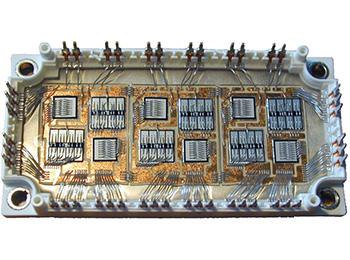
Current methods for monitoring the health status of power semiconductor components, in real time, in operating electronic equipment, are very complex and therefore expensive to implement. Thanks to the discovery of a new unique temperature-independent aging indicator it has now become very simple and economical to diagnose the state of health of these components. The result is a drastic reduction in the cost of maintenance that opens the way to new fields of application previously unthinkable.

Les gliomes pédiatriques de haut grade sont des tumeurs cérébrales particulièrement agressives et de très mauvais pronostic. Dans ces tumeurs, qui sont souvent mutées pour le variant H3.3 de l’histone H3, un défaut de réparation de l’ADN dépendant de l’enzyme PNKP a été identifié. L’instabilité génomique qui en résulte est un moteur de transformation des cellules cancéreuses. Les inventeurs ont montré que l’inhibition de l’expression de PNKP provoque spécifiquement l’arrêt de la prolifération des cellules porteuses de ces oncomutations. Ces résultats prometteurs ouvrent la voie au ciblage de PNKP comme nouvelle stratégie thérapeutique.
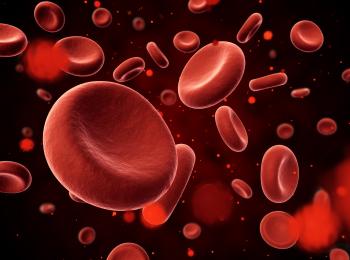
Les pathologies érythrocytaires telles que la drépanocytose et la sphérocytose héréditaire représentent un enjeu croissant de santé publique en raison de l’augmentation de la diversité de la population française. L’ektacytométrie, technique actuelle de référence pour mesurer la déformabilité érythrocytaire, présente des limitations importantes : elle mesure la déformabilité moyenne d’une population de globules rouges sans accéder à l’hétérogénéité cellulaire, et son coût reste élevé. Afin de relever ces défis techniques, les inventeurs ont développé une méthode basée sur l’utilisation de rotors moléculaires dont l’émission de fluorescence est reliée à la rigidité des globules rouges. Cette technologie permet de mesurer la rigidité à l’échelle de la cellule individuelle ainsi que l’hétérogénéité mécanique et morphologique de la population cellulaire, paramètre déterminant de la sévérité des pathologies érythrocytaires. Cette approche innovante vise à améliorer le diagnostic des membranopathies et le pronostic de ces pathologies érythrocytaires.
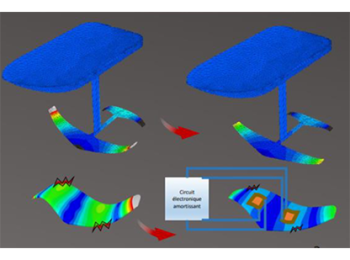
Procédé de fabrication de structures aérodynamiques ou hydrodynamiques en matériaux composites, permettant l’incorporation de capteur ou actionneur piézoélectrique à l’intérieur de la structure, sans impact sur la géométrie extérieure.
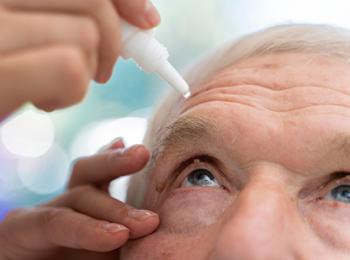
Les traitements actuels du glaucome contiennent des conservateurs ou des agents tensioactifs qui ont des effets collatéraux délétères (allergie, inflammation, effet détergent). Pour y répondre les inventeurs proposent de nouvelles compositions ophtalmiques, comprenant des émulsions non-ioniques huile-dans-eau (émulsion de Pickering) et stabilisées à l’aide de nanoparticules organiques. Ces nouvelles compositions ophtalmiques peuvent contenir des principes actifs peu solubles (ex. : stéroïdes et prostaglandines ) et assurer leur libération prolongée à la surface de l’oeil. Ainsi elles pourraient être utilisées pour le traitement d’inflammations oculaires ou le glaucome.
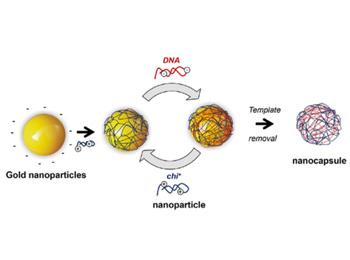
Idiopathic Nephrotic Syndrome (INS) accounts for 85% of glomerular nephropathies in children and 25-30% of those in adults. Pathogenesis of this syndrome is based on an immune disorder whose mechanism remains incompletely understood. The team has identified a promising protein target to develop gene therapy for INS. However, no simple technique compatible with a gene therapy treatment has shown efficiency to target the podocyte so far. Vectors classically used in gene therapy (adenovirus, retrovirus, etc.) do not allow for proper targeting of the podocyte due to the presence of a glomerular barrier. Thus, the inventors have developed nanocapsules consisting of multilayers of chitosan/DNA assembly as a vector carrier allowing specific expression of miRNA in podocytes. This therapeutic approach has been validated in vitro and optimized for in vivo use, making it possible to envisage new therapeutic perspectives for INS in humans. This new innovative expression nanocapsule can be optimized for other therapeutic uses.
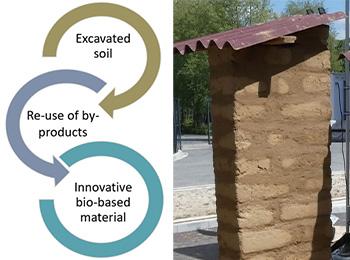
Reducing the environmental footprint of building materials is a major challenge in the construction industry. This innovative process makes it possible to reinforce a wide range of excavated soils by making them suitable for raw earth construction. Compressed earth blocks possessing enhanced mechanical properties and water resistance are fabricated with addition of biopolymers. These clay materials, 100% geo-based and bio-based, are an ideal solution for building the city of tomorrow.
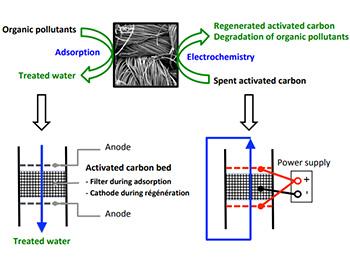
The development of efficient water filtration systems is an important challenge for environmental engineering. Activated carbon is widely used for the adsorption of organic pollutants, such as pesticides, pharmaceutical by-products and volatile organic compounds. However, it is only a separation step and the regeneration processes of the adsorption material currently present some important drawbacks. A new electrochemical process for in-situ regeneration of activated carbon has been developed. Both adsorption and regeneration steps are performed in the same reactor. The objective of electrochemical regeneration is to recover the adsorption capacity of the adsorption material and to degrade organic pollutants. The technology was initially developed using activated carbon fibers, a breakthrough material allowing faster adsorption of organic pollutants. The technology is also applied for the regeneration of conventional activated carbon grains.
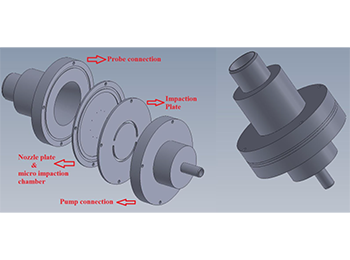
The invention is an instrument measuring the concentration of fine particles in the air. It consists of an aerodynamic stage screening device directing aerosol particles according to their mass to microbalances. The choice of this instrumentation is in accordance with the standard procedures used in the field of aerosol measurement to evaluate indoor air quality. The desire to target aerosols of biological origin such as microfungi is linked to health issues, as these microbes cause allergies. Real-time and continuous monitoring of the presence of particulate matter in the air will allow more accurate analysis of outdoor and indoor air quality.
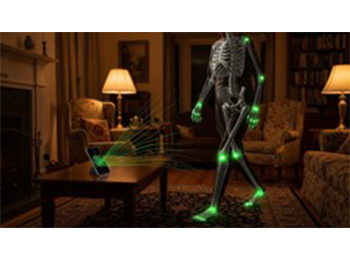
Current fall detection solutions for the elderly persons (necklaces, watches) have a rate of false alarms that is too high. The radar system developed by the ETIS laboratory allows for continuous and non-intrusive monitoring, with detection of gait deterioration and prevention of fall risks.
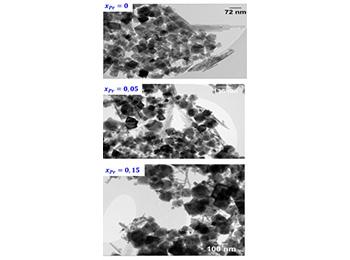
There are a multitude of methods for producing magnetic nanoparticles with a given magnetic behavior (paramagnetic, ferromagnetic, etc.) and a given magnetic category (soft, semi-hard, hard). But for the same composition of precursors and a given process, there is still no simple and effective way to modulate the magnetic category. Based on coprecipitation of precursors and a hydrothermal and/or solvothermal synthesis, this innovative production process allows to easily choose the magnetic category (soft, semi-hard, hard) of the nanocomposites while using the same composition of precursors.
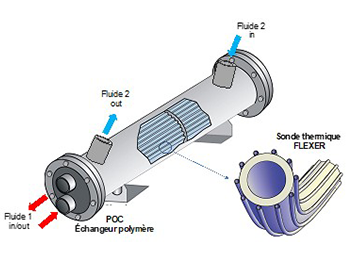
Nouvel échangeur de chaleur basé sur un matériau à faible coût, facile à installer et à entretenir. Il repose sur une structure polymère flexible et laissé libre dans un fluide externe en mouvement.
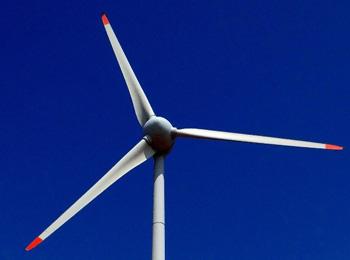
Wind turbines are used more and more to participate in the energy transition of countries. However, their operating range is limited depending on windy conditions, which could jeopardize the viability of certain projects.
The technology developed makes it possible to respond to this problem. The researchers have developed a process that allows, depending on the wind turbine installation conditions, to select the most suitable material. The latter will deform according to the chord under the force of the wind and the centrifugal force to optimize the efficiency and the operating range of the wind turbine, while ensuring its proper functioning in the face of strong winds.
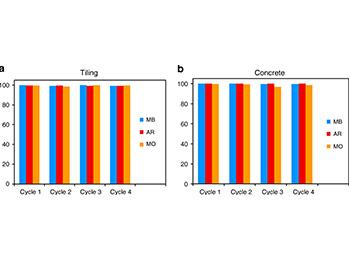
The invention presents a direct growth method of ZnO nanowires on civil engineering elements intended for photocatalysis for water and/or air depollution. Due to their high surface-to-volume ratio, ZnO nanowires showed excellent efficiency in the decomposition of tested dyes (AR14, MB, and MO) into less harmful products such as CO₂ , H₂O, NO³⁻, or SO₄²⁻ via a photocatalytic-induced mineralization process.
The civil engineering element coated with ZnO nanowires on its rough surface produced with this method can be integrated for instance in the development of the 5th-generation (5G) road, public garden, or in new buildings/houses. Smartly designed with new and possibly bio-based materials, 5th generation plans to make smarter roads in the near future will integrate numerous technologies including an environment depollution function. The photocatalysis process is a promising emerging solution for this aim, as it is a cheap and fast solution to degrade toxic organic compounds into harmless products. With the present invention, the photocatalysis process can be incorporated into our everyday life. Thus, incorporating metal oxide semiconductors (photocatalysts) onto civil engineering materials is a smart way to achieve this goal, as they are known to perform photocatalysis under ultraviolet lighting, or even under visible lighting with doped photocatalysts.

Ce logiciel détecte les éléments du graphique (barres, axes, ticks, labels, légendes, titres, tranches, symboles, bordures) à partir d’images, et rend le contenu interrogeable via un assistant vocal et/ou textuel. Il est compatible avec les lecteurs d’écran standards.

Electricity cost is one of the main expenses in water electrolysis, so improving conversion efficiency in electrolysers is crucial. Our innovative Anion Exchange Membrane (AEM) water electrolysis cathode catalyst rivals the efficiency of Carbon-Platinum (Pt/C) at a much lower cost. It combines nickel with a small amount of a Platinum Group Metal (PGM) through a unique one-step synthesis. In a three-electrode setup at 20°C and 0.1 mol/L KOH with a 10 mA/cm² current density, pure Ni stands at -280 mV overpotential, while our catalyst shows -110 mV, close to Pt/C 60%’s -105 mV, thus enhancing both affordability and performance in hydrogen production. At 1 mol/L KOH, our catalyst’s overpotential even drops to -65 mV, versus -50 mV for Pt/C 60%.
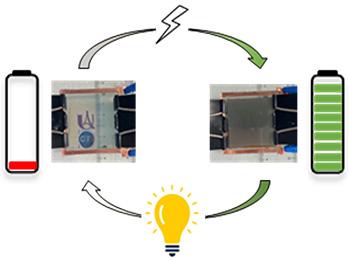
The development of bi-functional smart window, which combine reversible battery-type electrochemical energy storage and electrochromic properties, is an significant step forward to tackle the energetic footprint of buildings. These innovative aqueous based devices can reversibly switch from a transparent discharged state to a colored (even fully opaque) charged state. When integrated in “green” buildings, they efficently regulate light and heat transfer, thus
reducing the energy consumption and recycling stored energy. The selling point of our approach lies in leveraging Reversible Zinc Electrodeposition (RZE) on a transparent conductive oxide anode, with the possibility of combining various electrochromic materials at the cathode.
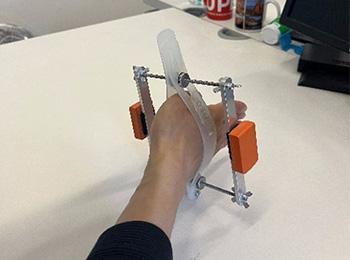
Les affections neurologiques du mouvement perturbent l’exécution des mouvements alternatifs qui sont la base de la plupart des gestes quotidiens. Parmi ces affections, la maladie de Parkinson affecte surtout les mouvements de grande amplitude (hypométrie). La réalisation de ces mouvements fait partie de l’examen clinique standard, cependant de façon non quantifiée compte tenu notamment de l’absence d’outil permettant de mesurer de manière simple et rapide les différents paramètres cinématiques de ces mouvements alternatifs rapides. On cherchera, en comparant un échantillon de sujets sains et un échantillon de sujets parkinsoniens modérés, les paramètres cinématiques du mouvement (amplitude, vitesse, accélération, fluidité) les plus discriminants par rapport au mouvement normal.
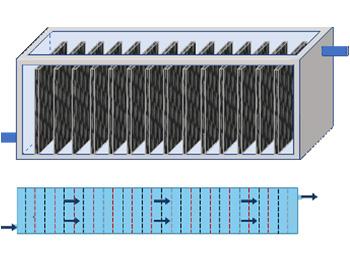
Biological treatments play a crucial role in removing organic and nitrogen compounds from wastewater with high cost-effectiveness. However, these technologies face limitations when dealing with industrial wasterwater containing biorecalcitrant organic compounds. This innovative anodic oxidation reactor tackles the issue by oxidizing the biorecalcitrant compounds, non selectively and transforming them into more biodegradable forms, to achieve a synergistic effect with a post-biological treatment. This combination of treatments aims at reaching high removal yields, for a wide range of industrial wastewaters with optimized energy consumption.